
A real emergency call has a certain weight to it. You can hear it in the customer’s voice, you can picture the water spreading, and you know every minute matters.
A fake emergency call feels different, but only after you’ve been burned a few times. It wastes fuel, kills your schedule, rattles your techs, and sometimes it’s not “just” a prank, it can be a setup.
This guide shows how performance seo plumbers can use simple call screening and better lead tracking to keep real emergencies moving and junk leads out of the truck.
Fake calls usually fall into three buckets:
Time-wasters: Someone bored, angry, or “testing” your business.
Competitor sabotage: A rival (or a lead seller trying to make you blame your marketing) floods you with low-quality calls.
Scam or crime setups: Some calls are meant to collect personal info, push odd payment demands, or see if you’ll leave your shop or home unattended. Stories of criminals posing as plumbers and targeting residents have been reported by law enforcement and news outlets (for example, the Seattle Police Department’s report on a thief posing as a plumber: https://spdblotter.seattle.gov/2015/04/15/thief-poses-as-plummer-scams-91-year-old-other-seattle-residents/).
The hard part is that scammers copy real “emergency” language: flooding, no water, sewage backup, “I need someone now.” Your dispatcher’s job is to sort urgency from authenticity, fast.
A fake call doesn’t just cost a trip charge.
It hits you in layers:
This is exactly where performance-driven marketing earns its keep. If you only measure “calls,” you’ll keep paying for noise. If you measure verified leads and booked jobs, fake calls stand out quickly.
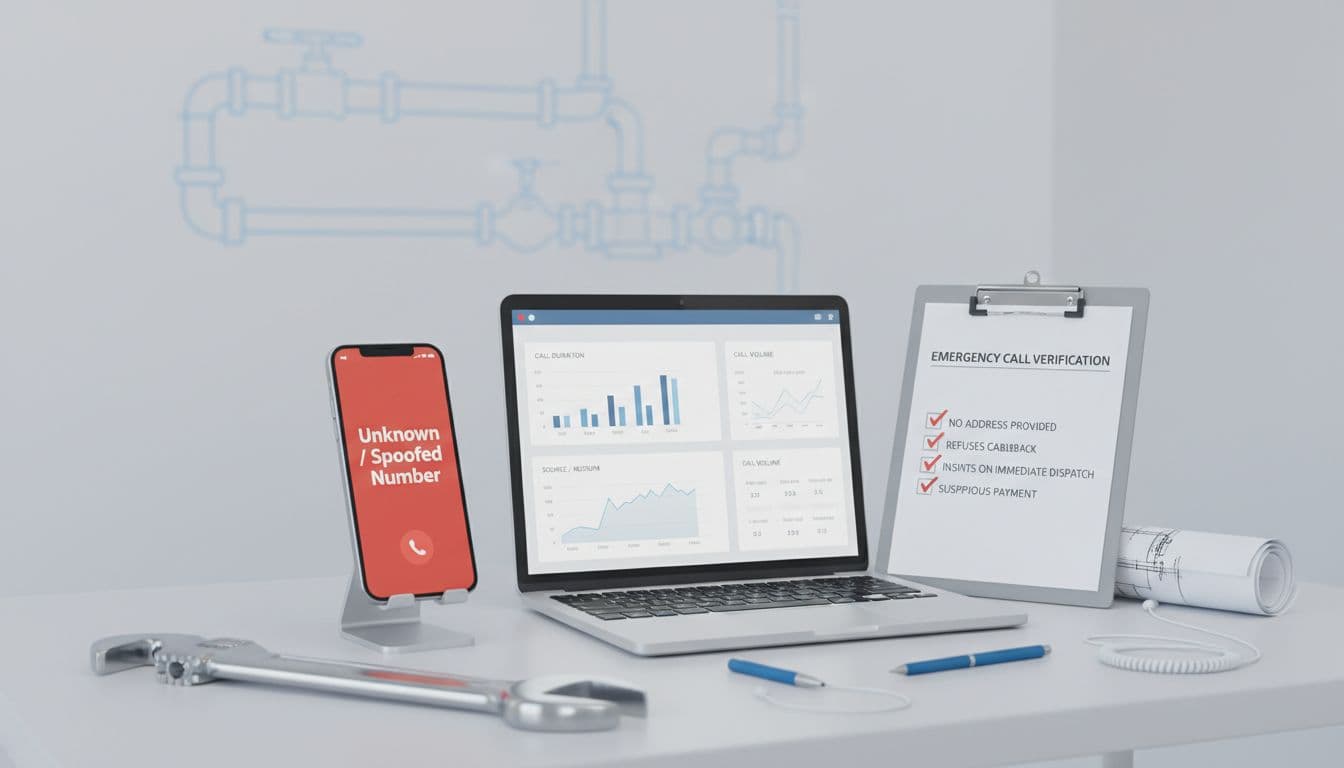
You don’t need a long interrogation. You need a consistent micro-process.
Here are the fastest tells, based on common scam patterns and what contractors see in the wild:
| Red flag on the call | What to do next |
|---|---|
| Won’t give an address (or gives a vague one) | Ask for a cross-street, then request a text with the full address |
| Refuses a callback from your office line | Say you can’t dispatch until a quick callback confirms details |
| Over-the-top urgency but no clear problem | Ask, “Where is the water coming from right now?” |
| “Send someone, I’ll explain when they arrive” | Require a basic description before booking |
| Weird payment pressure (cash-only, odd prepay request) | Stick to your normal payment policy, don’t make exceptions |
| Name doesn’t match caller ID, or number looks spoofed | Confirm by text, then callback, then book |
Scam calls often add pressure and remove specifics. Real customers might be stressed, but they can still answer basic questions.
For broader examples of how plumbing scams work (from the homeowner side), this breakdown is a useful reference: https://www.bigbhomepro.com/blog/the-most-common-plumbing-scams-and-how-to-avoid-them/
A good script feels like safety and professionalism, not suspicion.
Try this tone:
Step 1 (confirm the emergency): “Tell me what’s happening right now. Is water actively running or is it contained?”
Step 2 (confirm the location): “What’s the full service address, including unit number?”
Step 3 (confirm access): “Will someone over 18 be on-site to let our tech in?”
Step 4 (confirm a callback number): “If we get disconnected, what’s the best number to reach you? I’m going to read it back.”
Step 5 (set expectations): “We can dispatch, but first we confirm details and the diagnostic. You’ll get a text with the appointment window.”
Two quiet benefits happen here: you filter fakes, and you reduce no-shows because you’ve set a clear process.
Most plumbers don’t need “more leads.” They need more of the right leads.
That’s the difference with performance seo plumbers strategies that are built around outcomes, not activity. The goal isn’t rankings for vanity keywords, it’s predictable calls that turn into booked jobs.
Here’s how to connect SEO to call quality, without guessing.
If your reporting says “124 calls,” it’s incomplete. You need call outcomes:
Call tracking and recordings make this easier. So does asking your team to tag call outcomes in your CRM or field service software.
When you do this, patterns show up fast: one keyword, one page, or one directory listing can be responsible for most garbage calls.
Fake callers love vague companies with vague processes. Your site can quietly screen them out.
On your emergency page, add:
Service area clarity: City list, zip codes, and “outside this area, we can’t dispatch.”
Emergency definition: “Active leak, sewer backup, no water, no heat” (whatever fits your business).
Upfront policies: Diagnostic fee, after-hours fee, and what payment types you accept.
Real customers appreciate clarity. Scammers hate it.
If you want a solid overview of what plumber SEO pages should include (maps, services, reviews, on-page structure), this guide is a good comparison point: https://www.housecallpro.com/resources/plumbing-business-seo/
When your Google Business Profile and website show consistent trust signals, you attract higher-intent callers and fewer strange ones.
Proof signals include:
This won’t stop every bad call, but it helps shift your call mix toward serious customers.
Traditional SEO reports can look “good” while your office is drowning in junk calls.
A performance approach forces a better question: what did we produce that you’d actually want to pay for?
To make that real, insist on reporting that ties together:
Rankings you care about: Emergency plumber + your service cities.
Call source: Google Maps, organic search, Local Services Ads, directories, or referral.
Lead verification: How many calls were real, and how many were spam.
Booked jobs: Even if it’s a weekly sample, you need a feedback loop.
When you track outcomes, you can also spot bad actors faster. Some scams aren’t just fake callers, they’re fake “plumbing companies” or misleading listings that confuse customers and muddy the market. For a quick look at common scam tactics in the trade, this article is helpful: https://conyersplumbing.com/2023/08/28/how-to-avoid-plumbing-scams/
Marketing fixes take time. Dispatch fixes can start this afternoon.
A few safeguards that work:
Callback rule for after-hours: No dispatch until the caller answers a quick callback.
Text confirmation: “Reply YES to confirm the address and appointment window.”
Safe dispatch policy: If a call feels off, send two-person teams or verify again before arrival.
One trusted “cancel phrase”: Give techs a simple office-approved way to leave if the situation feels unsafe.
Fake emergency calls aren’t just annoying, they can create risk. Your process should protect your people first.
Fake emergency calls steal time the same way a slow leak steals water, quietly, job after job. A tight verification script stops most of them, and better tracking shows exactly where the rest are coming from.
When performance seo plumbers teams measure verified calls and booked jobs, not just “call volume,” the junk gets obvious fast, and your marketing starts paying for itself in a way you can actually feel on the schedule.


