
A lot of small business owners add a Google map to their site and expect a ranking lift. Sometimes that helps a bit. Often, nothing changes.
The reason is simple: an embedded map is a supporting signal, not a main ranking factor. It can make your location clearer, improve trust, and help visitors take action. Still, it won’t carry weak local SEO on its own.
An embedded Google map can help local SEO, but the effect is usually modest.
It seems to help more with organic local relevance than with direct Google Maps pack rankings. In plain terms, it can make a location page or contact page easier for Google to understand. That’s useful, but it’s not the same as outranking stronger local competitors.
A good example comes from a SearchPilot case study on embedded maps. After removing map components from local pages, the site saw a statistically significant drop in organic traffic. That doesn’t prove a map embed is a major ranking factor. It does show that removing local context can hurt.
At the same time, most local SEOs don’t treat map embeds as a high-priority fix. A recent thread on the Local Search Forum points to the same pattern: limited impact on map pack rankings, possible upside for organic pages, and no reason to expect miracles.
A Google map embed can help local SEO make more sense, but it won’t rescue weak pages, weak reviews, or a weak Google Business Profile.
So if you’re asking whether a map embed is worth adding, the answer is usually yes. If you’re asking whether it’s enough to move rankings by itself, the answer is no.
A map embed gives Google and your visitors another clue about where you do business.
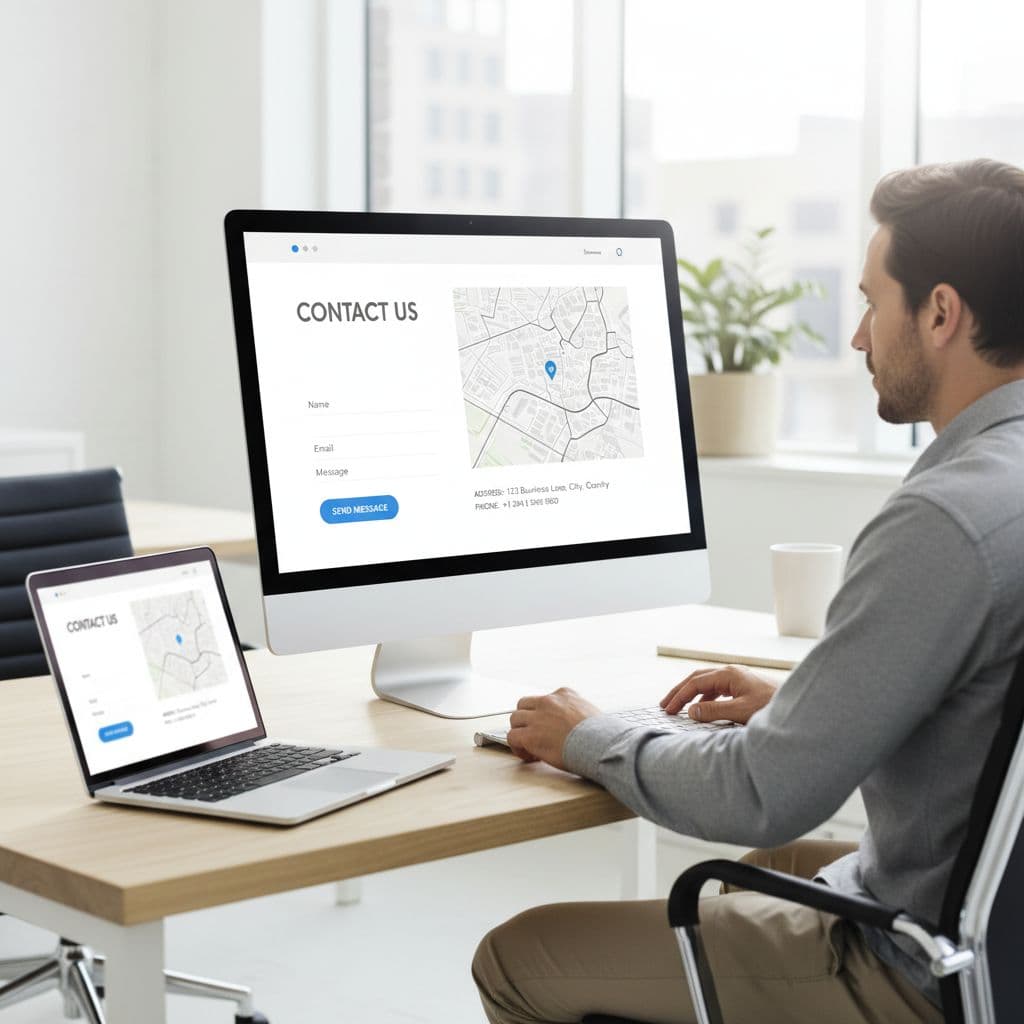
When the map matches your real location, it supports the address on the page. That matters more when the page also includes your business name, address, phone number, hours, and locally written copy. Google doesn’t rank the iframe itself. It reads the full page context around it.
That context is where local SEO gains show up. A contact page with a real address, embedded map, clear service details, and local business schema sends a stronger signal than a blank page with a form.
There’s also the visitor side. People want proof that you’re nearby and real. A map helps them confirm your location, plan a visit, and trust that the business exists. Better user confidence often leads to more calls, direction requests, and form fills. Those aren’t direct ranking factors in a simple one-to-one way, but they often support stronger local performance over time.
Current local SEO best practice is pretty consistent. Put the map on your contact page. Add it to location pages if you have more than one office. Keep your full NAP nearby. Use the exact business location, not a broad city search. Also, pair the map with real local text, not just an empty embed dropped into the page.
As Norsu Media’s write-up on map embeds and local visibility notes, the value is mostly about clearer location signals and better user experience. That’s the right way to think about Google Maps local SEO. Helpful, grounded, and real, not magical.
Placement matters. A map belongs on pages where a visitor would expect to see one.
The best spots are usually your contact page, your main location page, and each individual branch page if you have multiple offices. An about page can also make sense if it talks about your office or showroom. A service-area page can work too, but only if the map supports real location information.
This quick comparison keeps the setup practical:
| Page or setup choice | Best option | Avoid |
|---|---|---|
| Contact page | Exact business location with full NAP nearby | A map with no address details |
| Multi-location site | One unique map per location page | One generic map on every page |
| Service-area business | Use a map only if tied to a real public location | Fake offices or broad area maps |
| Embed method | Static map embed from your real listing | Dynamic search links or vague area views |
| Page content | Local copy, directions, parking, service details | Thin pages built only for SEO |
The takeaway is simple. The map should help a real person do something useful.
If you copy the embed from Google Maps, make sure it points to your exact business listing. Then place it near your name, address, and phone number. Keep the page mobile-friendly and fast. One clean map is enough.
For multi-location businesses, each office should have its own page, its own map, and its own local copy. Reusing the same text across every city page weakens the page. It can also create the kind of thin content problem that leads to solving local SEO ranking problems later.
This is where many small businesses lose time and money.
An embedded map is fine. But if your Google Business Profile is weak, your reviews are thin, and your service pages barely mention the city you serve, the map won’t move the needle much.
Your bigger local ranking drivers are usually:
If your profile has visibility issues, start there. Fixing Google Business Profile visibility issues often has a bigger impact than adding a map to the footer.
The same goes for your main money pages. If they’re thin, vague, or disconnected from your location signals, improve them first. A guide on optimizing service pages for local search can help you spot what your site is missing.
This is also where performance-based SEO matters. Small business owners don’t need a monthly retainer full of low-impact tasks. They need work tied to rankings, leads, and real local demand. Adding a map is fine when it supports a stronger page. Selling it as the fix is another story.
A results-driven SEO plan puts the map in its proper place. It sits behind the fundamentals, not ahead of them. If an agency talks about guaranteed local growth because they embedded a map, that’s a warning sign. Honest local SEO work stacks signals that matter, then measures outcomes.
A map won’t help if the page itself is weak.
If you embed a map on a thin page with no local copy, no useful details, and no clear service focus, Google still sees a weak page. The map doesn’t hide that. It may even distract from the bigger issue.
Problems also show up when businesses use the wrong map. A broad city view, a fake address, or a hidden location creates mixed signals. That’s risky, especially for service-area businesses. If customers can’t visit the address, don’t pretend they can.
Too many embeds can also clutter the page and slow it down. One relevant map is helpful. Five maps on one page are noise.
The same rule applies to local SEO as a whole. Add signals that support reality. Skip signals that try to fake it.
A Google map embed can help local SEO rankings a little, mostly by reinforcing location relevance and helping users trust the page. That’s useful, but it’s still a secondary signal.
The strongest gains come from the basics: a healthy Google Business Profile, strong reviews, well-built local pages, and clear site structure. Add the map because it helps the page make sense. Don’t expect it to do the heavy lifting.


