Pay-for-performance SEO can feel refreshingly fair, you pay when rankings or leads show up. But the moment a “bad lead” lands in your inbox, the relationship gets tense. Was it outside the service area, a wrong number, a repeat caller, or a real prospect who just didn’t buy?
A clear lead dispute process fixes that. It turns “I don’t think this counts” into a fast, consistent decision that ops, finance, and account teams can back up later.
Why lead disputes happen (and why they drag on)
Most disputes aren’t about trust, they’re about missing definitions. One side thinks “lead” means “answered call with clear intent.” The other thinks it means “any tracked call or form fill tied to page 1 rankings.”
If you run any pay-per-lead or performance model, you’re dealing with the same core issue. Even large platforms have formal dispute paths. Google’s Local Services Ads ecosystem has its own lead-quality dispute mechanics, and changes to that system are closely watched by marketers (see this breakdown of a Google LSA lead dispute update).
Common dispute triggers in performance SEO and pay-per-lead:
Low intent: price shoppers, “just looking,” or someone seeking info only.
Bad data: spam, bots, robocalls, disconnected numbers.
Dupes: the same person calling twice in a short window.
Attribution fights: “They came from our referral,” not search.
When this isn’t handled fast, it becomes a backlog. Backlogs become billing delays. Billing delays become churn.
Set the ground rules before the first dispute
A fast dispute workflow only works if everyone plays by the same rulebook. Put these in writing in your SOW or billing rules, and keep a one-page version in your client portal.
Minimum definitions to agree on:
What counts as a lead (call duration threshold, form fields required, unique contact rules).
What does not count (spam, out-of-area, wrong service, job seekers).
Dispute window (recommended: submit within 48 hours of receiving the lead).
Decision window (recommended: agency decision within 24 to 72 hours).
Evidence rules (what proof is required, what’s optional, what’s not accepted).
If you want a reference point from pay-per-lead programs that pre-define “qualified,” skim how other providers frame lead quality and vetting (example: pay-per-lead marketing program positioning).
The 3-step Review-Approve-Reject workflow (built for speed)
Step 1: Review (triage in under 10 minutes)
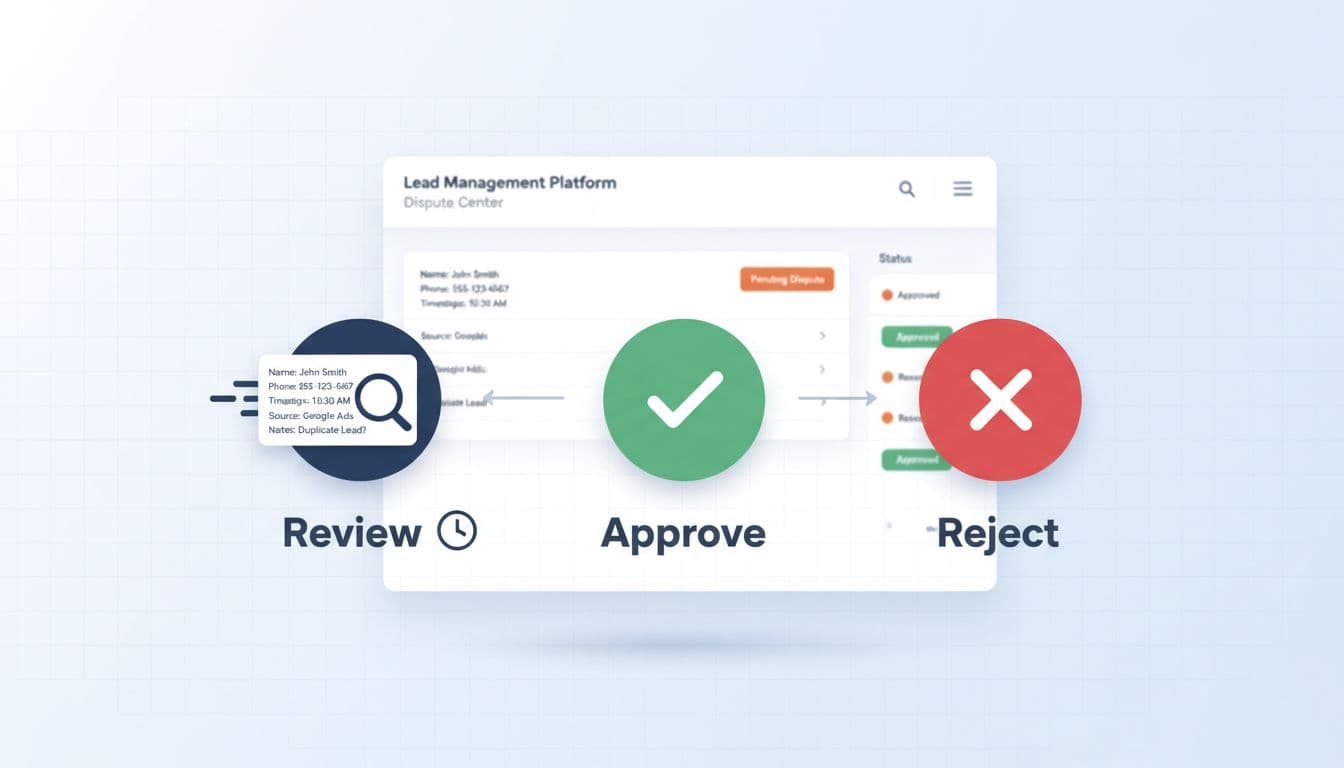
An AI-created illustration of a simple Review, Approve, Reject workflow inside a lead dispute dashboard.
Goal: confirm the dispute is complete and worth a decision.
Required inputs (if any are missing, return it as “Need Info,” not “Rejected”):
Duplicate within your defined window (example: same phone within 7 days), with both lead IDs shown.
Recommended timeframe: 24 to 72 hours from submission, faster if billing is pending.
Step 3: Reject (with a reason that stands up later)
Rejecting doesn’t mean “you’re wrong.” It means “this meets the agreed definition of a billable lead.”
Reject criteria:
Caller requested a service you offer and is in-area.
Form fill has valid contact info and a service request.
Call is a genuine inquiry even if they didn’t book.
Rejection best practice: always include the single strongest piece of evidence (time-stamped clip, transcript excerpt, or form payload). That prevents round two of the same argument.
Decision matrix: reason, evidence, outcome
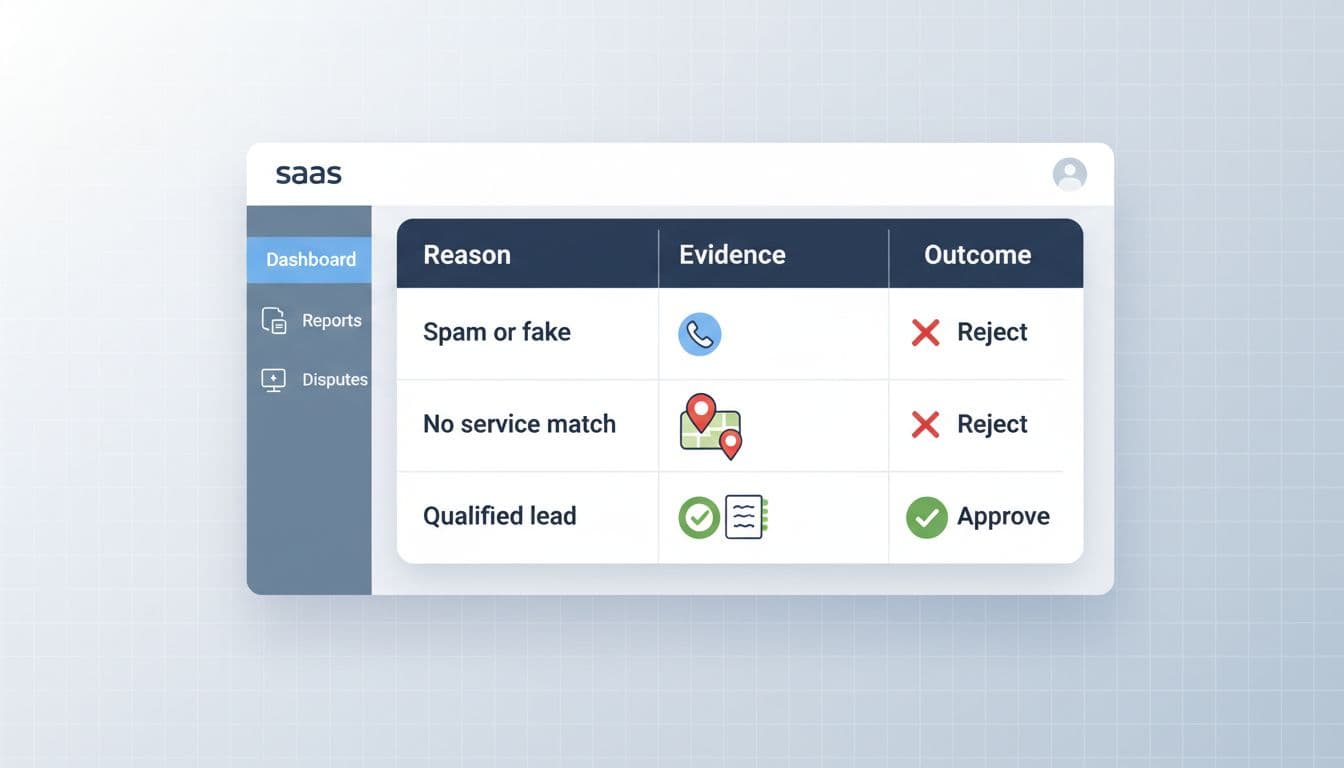
An AI-created illustration showing a simple decision matrix used to rule on disputed leads quickly.
Use a simple matrix so different reviewers reach the same call.
Reason (dispute type)
Evidence to check (minimum)
Outcome
Spam or fake lead
Call recording (robot), transcript, invalid form fields
Reject lead from billing (Approve dispute)
Wrong service
Caller states service you don’t offer, transcript timestamp
Approve dispute
Out of service area
Caller location stated, address in CRM, geo rules
Approve dispute
Duplicate lead
Matching phone or email, prior lead ID and date
Approve dispute (credit duplicate)
No contact made
Missed call plus no voicemail, no form, no callback attempt logged
Depends on your rules, document it
Qualified inquiry, no sale
Call shows real intent, in-area, service match
Reject dispute
Existing customer
CRM record shows prior customer status before lead date
Depends on your rules, document it
If you also run LSAs, you’ll notice similar categories show up in practical guidance on disputing poor leads (example: how to dispute bad leads in Google LSAs).
Timeframes that keep billing and trust on track
Time kills dispute fairness. People forget details, recordings get harder to find, and finance starts guessing.
Recommended SLAs:
Client dispute submission: within 48 hours of lead receipt.
Agency decision: within 24 to 72 hours.
Escalation (tie-break): within 2 business days after the first decision.
Billing lock: disputed leads are “on hold” until resolved.
A simple rule helps: if a lead is disputed, it pauses billing until a decision posts.
Audit trail and logging best practices (so disputes don’t come back)
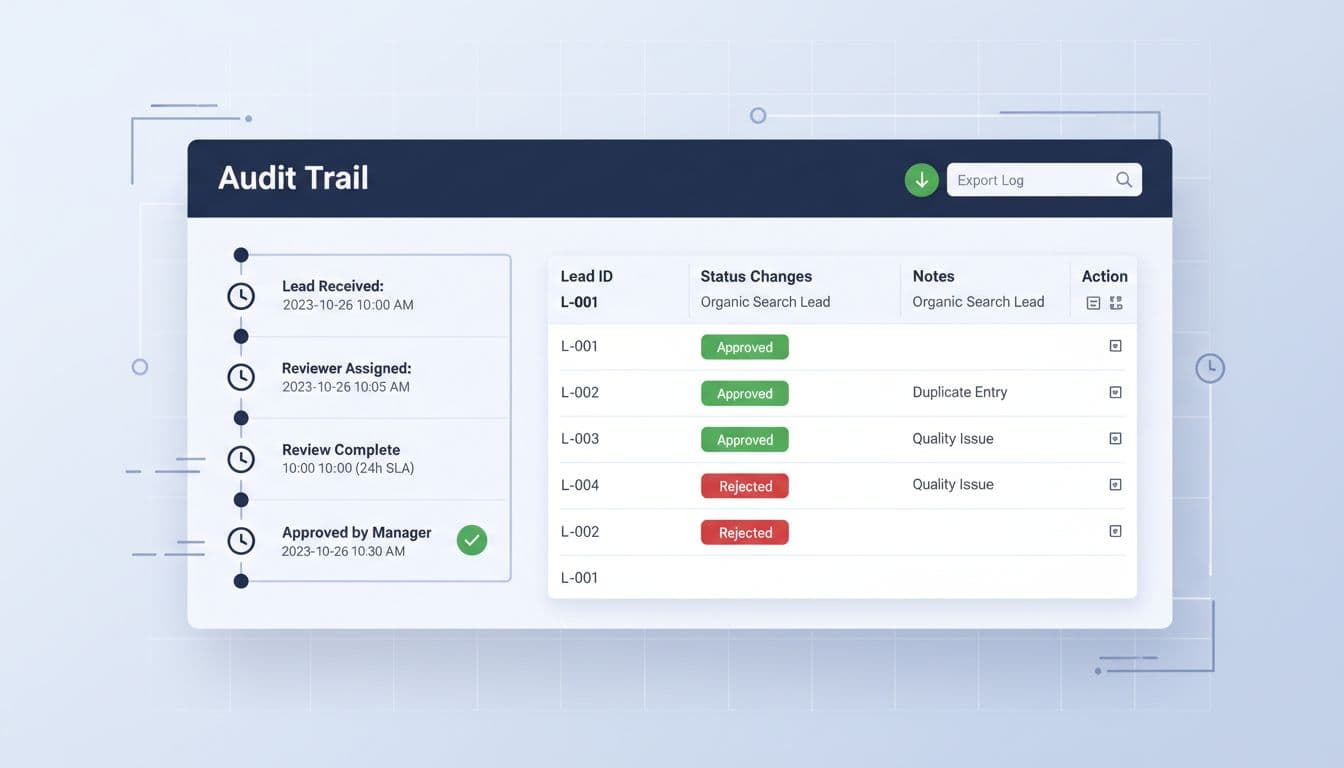
An AI-created illustration of an audit trail timeline showing lead status changes and reviewer actions.
Think of the log like a receipt. If you can’t show the “why,” you’ll re-litigate the same lead during renewals and audits.
Body: Thanks, we reviewed Lead ID ___. We approved the dispute due to ___ (evidence: ___). This lead will be credited on the next invoice (or removed from the current one). Status is now Approved.
Rejection message
Subject: Lead dispute decision (Lead ID: ___)
Body: We reviewed Lead ID ___. We’re keeping it as billable because ___ (evidence: ___). If you have new evidence, reply within 2 business days and we’ll re-check.
Monthly dispute-report KPIs (for ops and finance)
Disputes submitted (count)
Approval rate (approved disputes / total disputes)
Reversal rate (decisions changed on appeal / total decisions)
This article shares operational best practices, not legal advice. Your terms and billing rules should be reviewed internally for your business needs.
Conclusion
A pay-for-performance program lives or dies on trust, and trust comes from a consistent lead dispute process. Define what counts, decide fast, and log everything like you’ll need it in six months. When your team can review, approve, or reject in hours instead of weeks, billing stays clean and relationships stay calm. What would happen to your cash flow if every dispute had a clear decision within 72 hours?
Need Help? Get In Touch!
If you have questions about anything, please do not hesitate to contact us. All messages are responded to within 24 business hours (most within 1 business hour).
ANY QUESTIONS
Ready to Speak With a Marketing Expert
Contact Us
Our internet marketing experts are always available to assist you with any of your issues, needs or requests.
Launch Targeted Campaign
Our goal is to help clients plan, build, and execute their digital advertising campaigns using the best of human expertise
Achieve Lasting Growth
When you work with us, we want to be able to provide you with a unique service that helps your business grow, without having to invest a lot upfront.
Results-Based
We only start billing once we get you on page 1 of Google.
Affordable
Our monthly fees are made for small businesses.
Fast Results
Almost all of our clients get ranking within 1-2 months.
No Contract
We don't lock you in. All services are month-to-month.