
A pay-for-performance deal sounds simple until a real buyer shows up. They Google you, leave, come back direct a week later, then finally fill out a form after clicking a paid ad.
So who gets credit, and who gets paid?
In pay for performance SEO attribution, the hard part isn’t tracking “a lead.” It’s deciding what happens when the same prospect discovers you more than once, across multiple sessions, channels, and devices, in a world with GA4 modeling, consent banners, and fewer cookies.
Pay-for-performance SEO works best when each lead has one clear source. That’s not how B2B buying works.
A common journey looks like this:
If your contract pays on “SEO leads,” you’ll hit two problems fast:
Problem 1: Direct traffic steals credit. In GA4, direct is often just “we lost the trail.” It can be a bookmarked page, a copied link from Slack, or a return visit where consent blocked identifiers. Consent Mode and modeled conversions help, but they also mean you’re sometimes paying based on incomplete paths (good overview: Consent Mode and modeled conversions in GA4).
Problem 2: Repeat organic touchpoints look like two wins. If the same person comes from Google twice, a sloppy system can count it as two SEO events, even though it’s one buyer.
That’s why your agreement needs lead-level rules, not session-level logic. For a broader view of performance pricing structures, see A Guide to SEO Pay For Performance Models.
Think of attribution like a scoreboard for one match, not a points counter on every dribble.
Start by defining the payable unit:
Payable event (recommended): an approved lead created in your CRM (form, booked meeting, or qualified inbound call).
Not payable: visits, “organic sessions,” chat starts, or duplicate form fills from the same person.
Then add two guardrails that prevent double-paying when a prospect returns:
In practice, “buying entity” usually means company + person, using some mix of email, phone, and domain.
You don’t need perfect attribution. You need clear payout rules that both sides can audit.
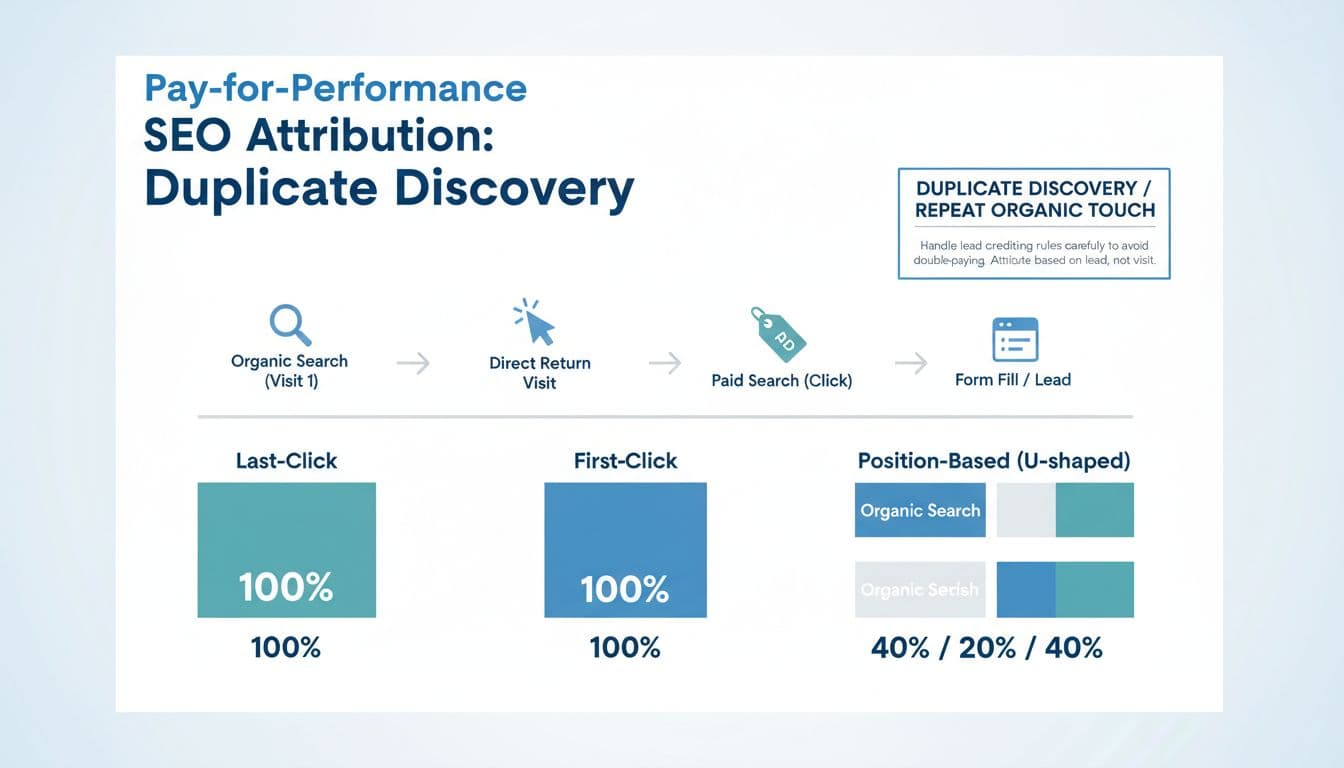
Rule: The last non-direct channel before conversion gets 100% credit. “Direct” never overrides a prior channel.
Best for: smaller channel mixes, teams that want a simple yes/no payout rule.
Rule: The first non-direct channel in the lookback window gets 100% credit.
Best for: long sales cycles where the first touch is the main battle.
Rule: Split credit across touchpoints, but only pay once per lead.
A clean default for B2B is a U-shaped split:
If you want to weight discovery more (common in SaaS content plays), you can set a “discovery-heavy” variant like 60/20/20.
Best for: most pay-for-performance SEO contracts where multiple channels influence revenue.
Use plain language like this:
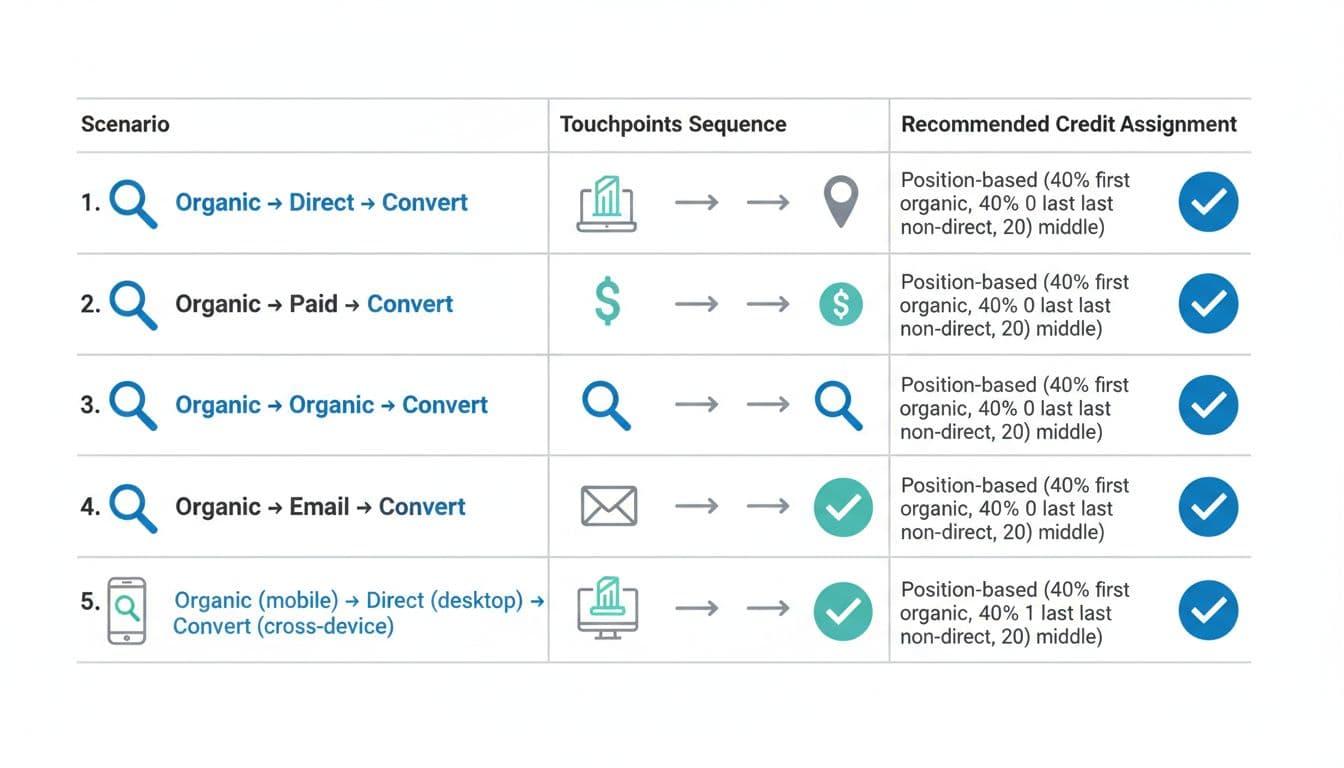
Below is a contract-friendly version you can paste into an SOW. It assumes position-based 40/40/20, last touch ignores direct, and credit aggregates by channel.
| Scenario | Touchpoints before conversion | Credit assignment (example) |
|---|---|---|
| 1 | Organic → Direct → Convert | Organic 100% (direct is neutral) |
| 2 | Organic → Paid Search → Convert | Organic 40%, Paid 40%, (no middle touches, remaining 20% split evenly, Organic +10%, Paid +10%) |
| 3 | Organic → Organic → Convert | Organic 100% (repeat organic is still one channel) |
| 4 | Organic → Email → Convert | Organic 40%, Email 40%, remaining 20% split, Organic +10%, Email +10% |
| 5 | Organic (mobile) → Direct (desktop) → Convert | Organic 100% if identity is matched, if not matched, treat as “unknown” and flag for review |
That last row is the one that causes the most fights. Cross-device is still messy in 2025, especially when consent is denied. Your contract should say what happens when identity can’t be resolved.
You don’t need a fancy stack, but you do need consistency.
utm_source, utm_medium, utm_campaign, landing page, and referrer into the CRM at submit time.When someone challenges a lead’s source, review these items in order:
When a buyer finds you twice, it shouldn’t create two payouts. It should create one lead with a sensible credit story.
The safest default for pay for performance SEO attribution in 2025 is position-based credit, a direct-is-neutral rule, and CRM-led deduplication. Put those rules in writing, then enforce them the same way every month.
If your current contract can’t answer “what happens when they come back again,” it’s not a performance agreement yet.


