
If you’re considering pay for performance SEO, the pricing sounds fair on paper. You pay when results show up, not just because a calendar flipped to a new month.
The hard part is defining what “results” means in a way that doesn’t invite arguments. Is a 12-second call a lead? What about a form with a fake email, or a chat that never mentions your service? Without clear billable rules, pay-for-performance turns into “pay-for-confusion.”
This guide lays out practical payment triggers for calls, forms, chats, and booked jobs, plus the guardrails that stop loopholes before they show up.
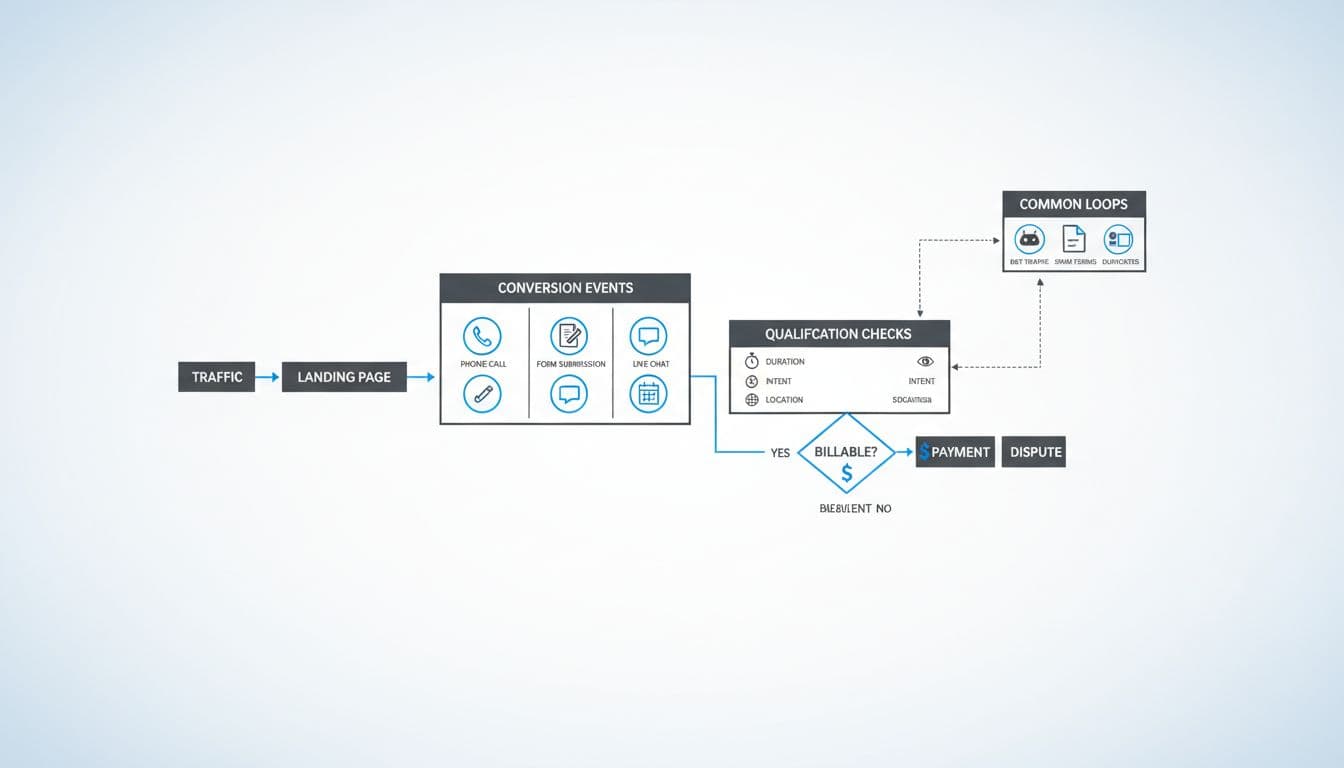
In performance deals, most fights happen because both sides use the word “lead” differently. Swap that word out and use billable event instead. A billable event is a tracked action that meets written qualification rules, with proof everyone agrees on.
Before you set thresholds, lock in four basics:
1) What you sell, and where you sell it
Your contract should name your services (and what’s excluded), your service area, and business hours. If you don’t serve it, it can’t be billable. Simple.
2) What “intent” means for your business
Intent can be defined in plain language: “The customer is asking for pricing, availability, scheduling, or a quote for a service we offer.” This avoids paying for job seekers, vendor pitches, and “just researching” calls.
3) The tracking sources that count as truth
Pick the systems that win if data conflicts (example: call tracking logs, CRM records, chat transcripts). Keep it boring and consistent.
4) The performance model you’re buying
Some programs bill off rankings, some bill off leads, some blend both. Recent commentary on performance-based models keeps repeating the same warning: define success upfront, and avoid paying for easy “vanity” wins that don’t turn into customers. If you want context on how these models differ, see a guide to pay-for-performance SEO. For a deeper overview of the upsides (and why many small businesses like the risk shift), read benefits of pay-for-performance SEO.
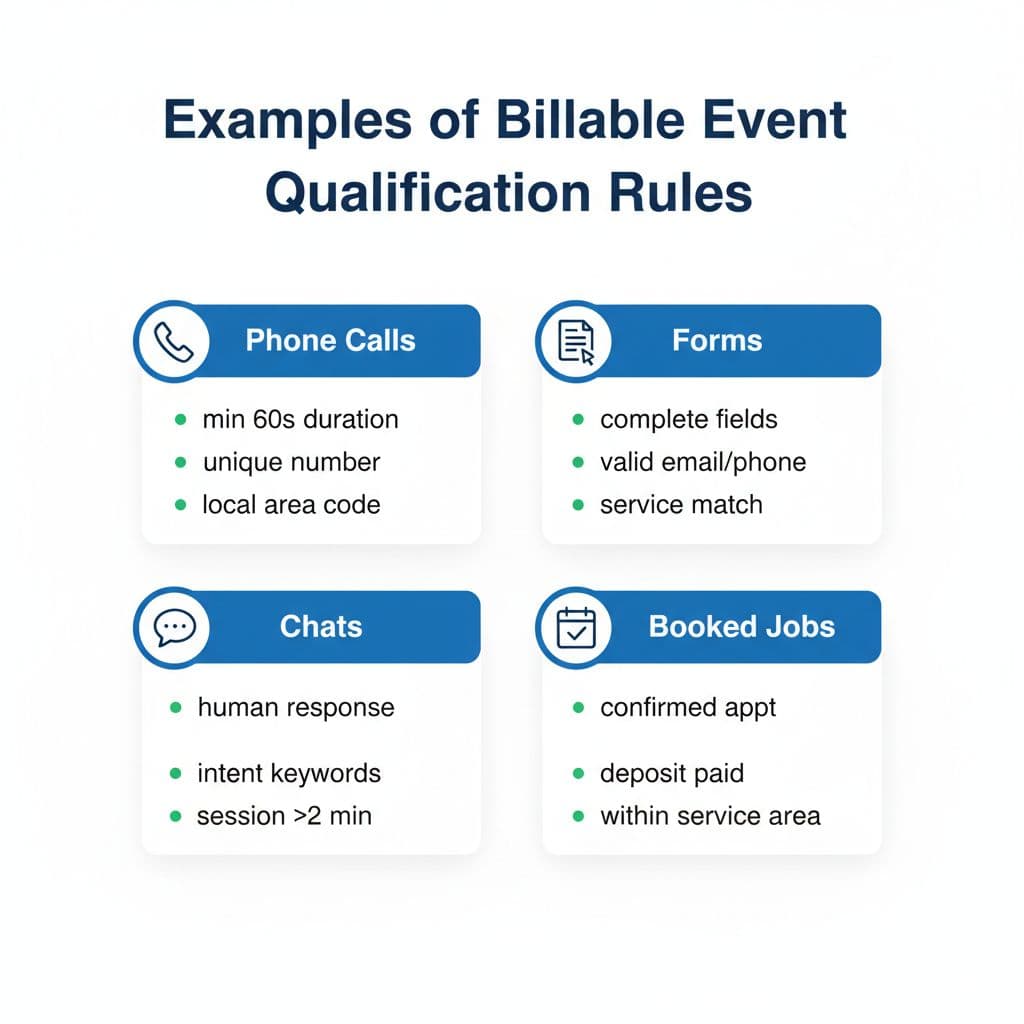
A good billable definition has two parts: a hard rule, and a clear way to verify it. Here’s a clean starting point you can adapt.
| Event type | Billable only if | Common loophole this blocks |
|---|---|---|
| Phone call | Meets duration and intent rules, from a unique number | Robocalls, misdials, repeat callers billed twice |
| Form submit | Valid contact info plus service request | Spam forms, missing details, fake emails |
| Live chat | Real conversation plus service intent | Bots, “hello?” chats, support questions |
| Booked job | Confirmed appointment (and optional deposit) | Unconfirmed holds, fake bookings, no-shows counted as wins |
A simple rule most small businesses can live with is: billable calls must be answered (or return-called), last at least 60 seconds, and include service intent inside your service area.
Good call qualifiers:
Also define what doesn’t count: blocked numbers (optional), wrong service, out-of-area, job seekers, vendor pitches, and obvious robocalls.
Forms are easy to fake, so don’t bill for “someone typed something.” Bill for a usable inquiry.
Form qualifiers that work:
If a form lands with “asdf” and no phone, it’s not an event. It’s noise.
Chats can produce great leads, but they also create “ghost conversions.”
Chat qualifiers:
Make sure transcripts are saved. If it can’t be reviewed later, it can’t be billed fairly.
Booked jobs sound like the cleanest trigger, until you ask what “booked” means.
Pick one:
Also decide whether reschedules stay billable (often yes) and whether cancellations reverse billing (often yes, within a defined window).
The best billable rules still break if you don’t cover the “what if” scenarios. These are the big ones.
Duplicates aren’t always fraud. Sometimes a real customer calls twice. Your rules should be predictable:
Tie identity to phone number and email, then confirm in your CRM.
Customers don’t shop in a straight line. They might Google you, leave, click an ad later, then call from your Google Business Profile. That’s why your agreement needs a basic attribution rule.
Practical options:
Whatever you choose, define the proof, usually UTM tags, GCLID, call tracking source, and CRM notes. Also consider a “direct traffic” exception, since many people type your name after finding you in search.
If you’re evaluating performance pricing, it helps to understand the risks across models, including why pay-only-for-rankings can push low-value targets. This breakdown of pay-for-performance SEO pricing and pitfalls explains the tradeoffs in plain terms.
A dispute process isn’t a sign of distrust. It’s the seatbelt.
Set these in writing:
If you want a ready-made structure, use this review-approve-reject lead dispute process as a reference point.
Finally, make billing easy to audit. Your invoice should list lead IDs, dates, sources, and the rule that made each event billable. If you’re comparing providers, transparent pricing helps too, see performance SEO cost structure.
Pay-for-performance only works when “billable” has teeth. Define the event, set the proof, block duplicates, and agree on a fast dispute window. That turns billing into math instead of debate.
If you’re shopping for pay for performance SEO, ask one direct question before you sign: “Show me the exact rules for what you bill, and how you prove it.” The best providers won’t dodge it, they’ll already have it written down.


