
If your business serves more than one town, your marketing can either feel like a magnet or like a sprinkler. Both “cover” a wide area, but only one pulls in the right jobs.
That’s why service area mapping matters so much in PFSEO campaigns. When your targeting matches where you can win (and where you actually want the work), you get more calls from better-fit customers, and you stop paying attention to “visibility” that never turns into revenue.
Below is a practical way to map service areas for PFSEO so your pages, Google Maps presence, and budgets all point at the same goal: ROI.
PFSEO (programmatic or portfolio-driven local SEO) works best when you treat locations like a portfolio. You don’t try to rank everywhere at once. You build and expand coverage in a controlled way, based on performance.
Service area mapping is the filter that keeps that portfolio profitable. Without it, the campaign often drifts into one of these traps:
A good map does the opposite. It helps you pick the areas with the best mix of demand, close travel time, decent close rates, and manageable competition.
If you want a deeper guide on choosing an SEO partner who’ll actually stick to measurable results, this checklist is worth skimming: step-by-step guide to choosing a local SEO partner.
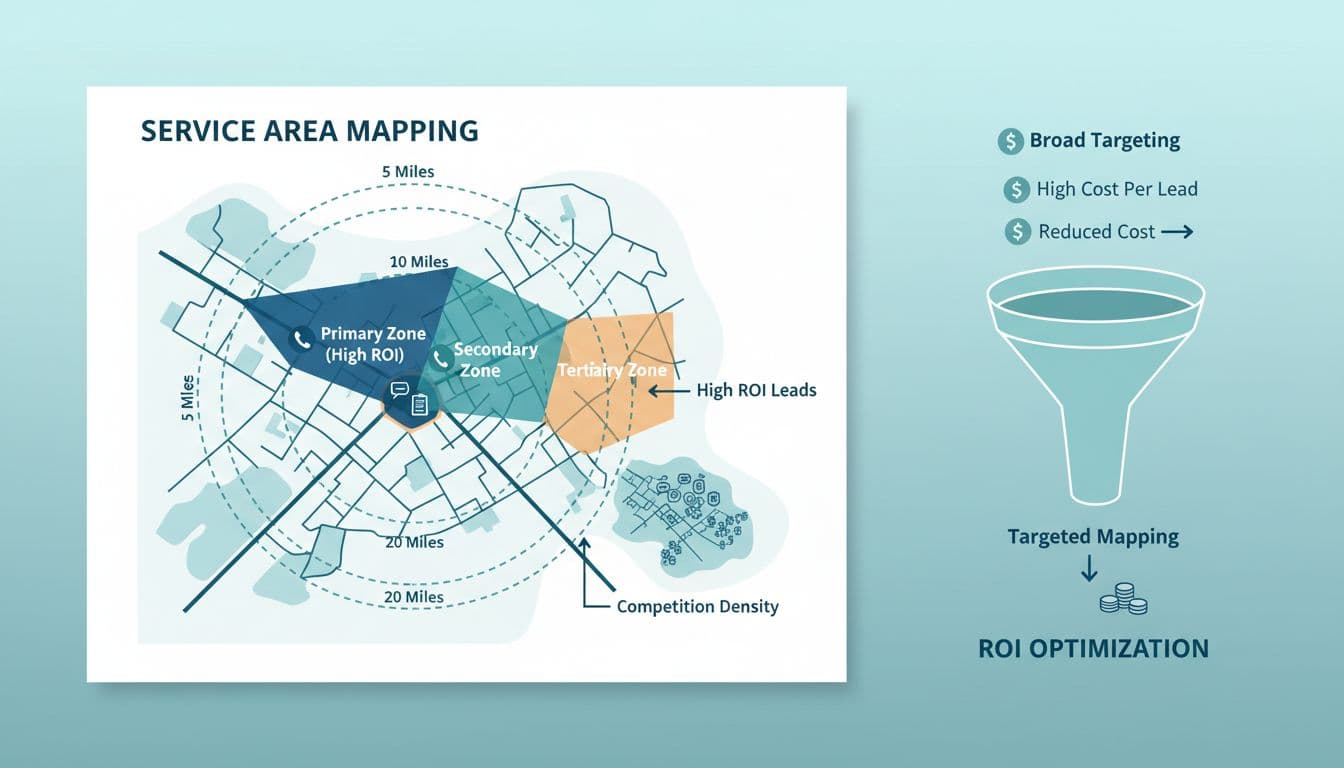
Think of your service area like pizza delivery. The closest neighborhoods get the fastest delivery and the best experience. The far edges can still be served, but they need stricter rules, or they start hurting margins.
Use a simple 3-zone model:
| Zone | What it means | What you optimize for |
|---|---|---|
| Primary (High ROI) | Where you want most of your jobs | Fast rankings, high conversion, strongest review proof |
| Secondary (Growth) | Solid areas that can scale next | More content depth, more reviews, steady expansion |
| Tertiary (Selective) | Edge areas you’ll take when the job is worth it | Limited targeting, only best-fit services |
Keep it simple, and use signals you already have:
Job history: Pull the last 3 to 12 months of closed jobs by ZIP code or city.
Profit: Some areas bring higher ticket sizes or fewer “problem” jobs.
Travel time: A common rule is to keep most coverage within about a 2-hour drive from your base, and avoid pretending you’re local everywhere.
Competition: If an area is stacked with strong providers, you may still target it, but you should know you’re choosing a longer fight.
A quick way to sanity-check your map is the 80/20 view: if 80 percent of your revenue comes from 20 percent of your service area, your primary zone should heavily overlap that 20 percent.
Once zones are set, PFSEO becomes much easier because each zone tells you what to build first.
Google Business Profile is picky about service-area businesses. In 2026, best practice is to list cities, ZIP codes, or named areas, not one giant radius. Keep it tied to where you truly operate, from your real base location.
If you need a simple explanation of how radius thinking affects visibility, this walkthrough is useful: Setting Your Google Maps Radius.
Key rule: don’t stretch your GBP service area to match your ambition. Make it match your operations.
Your map should control the page plan:
If you want a solid framework for what should be on these pages, BrightLocal lays it out well here: service area page SEO for local search visibility.
What “strong” means in practice: unique copy, real photos, reviews tied to that area, and FAQs that match how people actually ask for help. Swapping city names on the same paragraph doesn’t hold up for long.
This is where ROI shows up fast.
Primary zones can push faster-response offers (same-day service, emergency calls, free estimates). Secondary zones might need trust builders (warranties, financing, more proof). Tertiary zones often need qualification (minimum job size, service fees, or limited service types) so the leads you do get are worth the drive.
If you’re running performance-based SEO, zone mapping also keeps expectations clean. You’re not paying for “coverage,” you’re paying for outcomes in the areas that matter. If you want a clear view of how that can be priced, see these pay-only-after-ranking SEO packages.
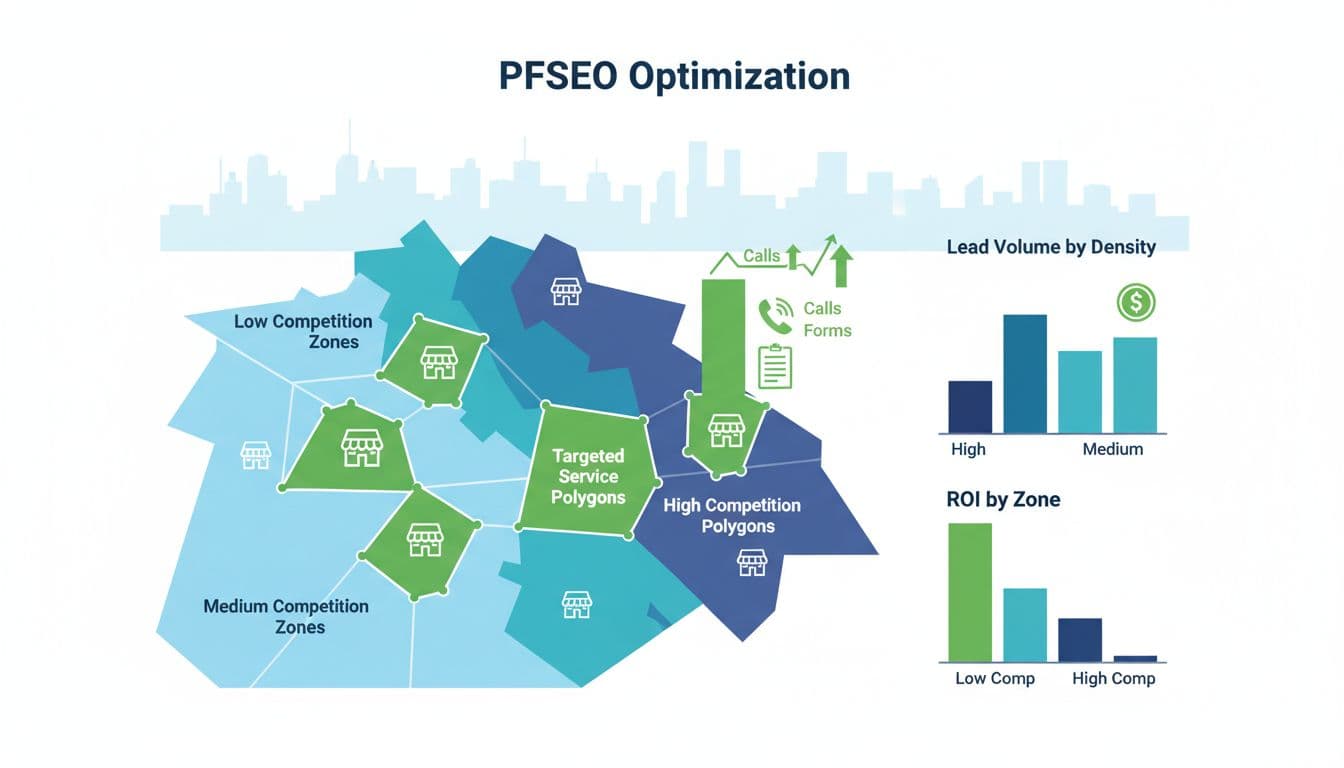
Competition isn’t just “how many businesses exist.” It’s how strong they are.
When you map competition, you’re looking for pockets where you can rank and convert sooner, even if they aren’t the biggest city on your list. Those wins build momentum, reviews, and brand searches, which then help you expand into tougher areas.
A practical approach:
Primary zone: include at least a few “winnable” areas, not only the hardest city nearby.
Secondary zone: mix medium competition areas with a couple harder targets.
Tertiary zone: save the big-name, high-competition locations until you have proof and authority.
A lot of local SEO reporting is about rankings. Rankings matter, but mapping is about profit.
Track each zone with three simple metrics:
Lead volume: calls, forms, chats.
Lead quality: booked jobs, average job size, close rate.
Cost per booked job: what it costs to generate real revenue in that zone.
If you’re curious how some teams quantify local ROI with scoring models and location data, this overview gives helpful context: how business scoring APIs prove the ROI of local SEO.
The best part of zone tracking is that it creates clean next steps. If a secondary zone page ranks but doesn’t convert, you adjust the page and offer. If it converts well, you add the next nearby city page and expand.
Even smart business owners get tripped up by these:
Mapping by ego: targeting the biggest city first because it sounds impressive.
Overstretching GBP service areas: listing far-away places “just in case,” then wondering why local relevance drops.
Too many thin pages: publishing dozens of near-duplicate pages that never earn trust.
Ignoring travel time: leads don’t help if you can’t serve them fast enough to win.
No review strategy by area: location-specific proof is a conversion booster, especially outside your home base.
Service areas aren’t just lines on a map, they’re boundaries around your profit. With service area mapping, PFSEO campaigns become easier to plan, easier to measure, and much harder to waste.
Start with three zones, build pages and Maps signals that match those zones, then expand only when the numbers say it’s time. The result is simple: more of the jobs you want, fewer of the leads you don’t.


