
If you run a home service business, you already know the painful truth: not every “lead” is a real lead. Some callers want a quote today, others want a price “for later,” and a few are just fishing for DIY advice.
A real time lead scoring model helps you treat incoming leads like a dispatch board, not a guessing game. It grades each lead the moment it happens, then routes it to the right person, fast, while the customer is still ready to book.
Performance SEO lives or dies on outcomes, not traffic charts. Rankings matter because they drive calls, booked jobs, and revenue. If your team answers every lead the same way, you waste time on tire-kickers and miss the hot ones.
Real-time scoring fixes that by doing two things at once:
This is also why results-based SEO models work best with strong lead scoring. When you only want to pay for work that produces results, you need tight tracking and honest attribution. If you’re pairing SEO with Google Local Service Ads for Home Services, scoring becomes even more important because lead volume can spike without warning.
Before you touch models or tools, define what “good” means for your business. In home services, “good” usually isn’t a form fill. It’s a booked job (or at least a scheduled estimate that shows up).
A practical scoring target (your “label”) could be:
If you use a CRM or scheduling system, you want the final status to flow back into your data. Without that feedback loop, your scoring turns into educated guessing.
For a helpful overview of common scoring frameworks, Twilio SendGrid’s guide on lead scoring models lays out the difference between behavioral signals and profile fit.
The trick is turning “stuff that happens on your site” into a score your team can act on immediately.
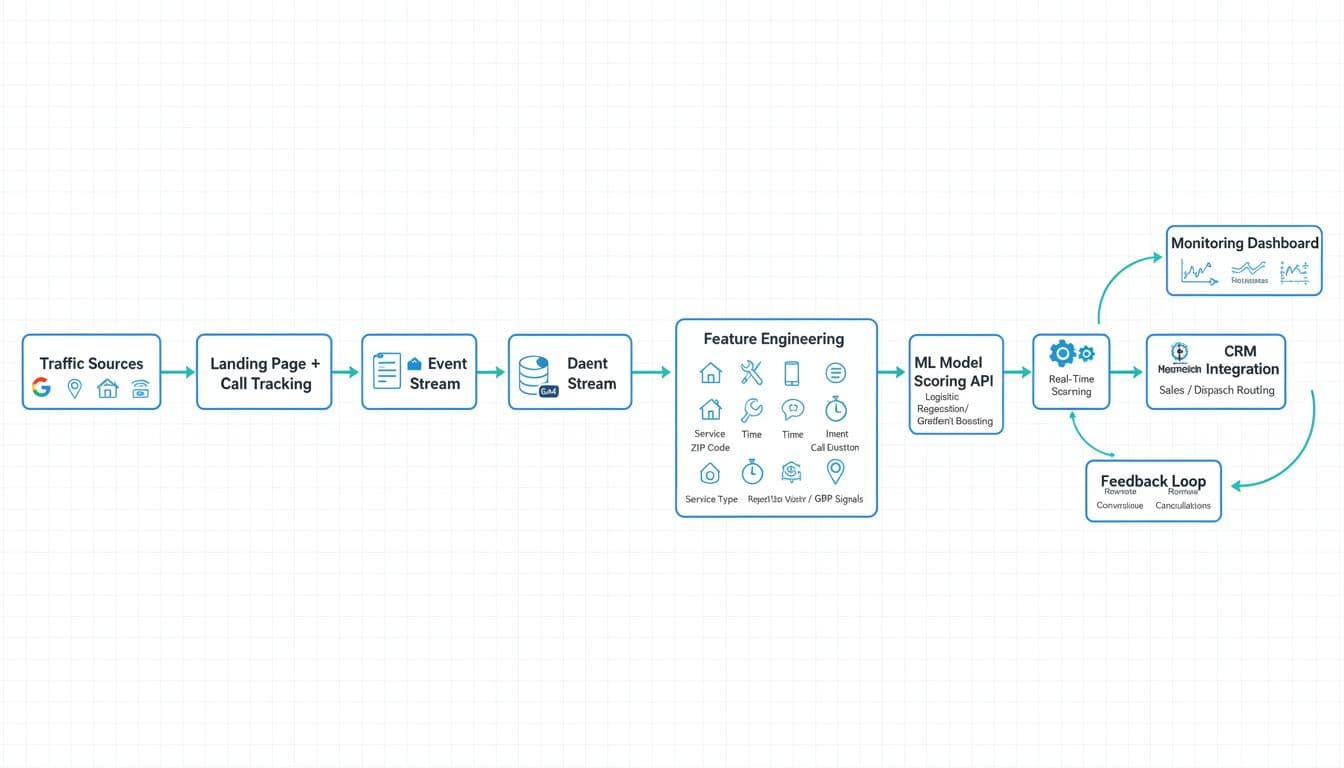
Here’s the clean version of the flow:
Search visit or LSA lead: Organic, Maps, Local Services Ads, sometimes even branded searches.
Landing page and call tracking: You need call tracking that ties calls to pages and sources, plus form tracking and click-to-call.
Event stream: GA4 events help, but many businesses move key events server-side so ad blockers don’t wipe out the data.
Data layer: A warehouse (often BigQuery) stores raw events, call metadata, and CRM outcomes.
Scoring service: A lightweight API (or automation) assigns a score instantly.
Routing: CRM, inbox, or dispatch gets the lead with context (score, reason codes, recommended next step).
If you want a step-by-step implementation checklist, Chatmetrics has a straightforward post on implementing real-time lead scoring that matches this same “collect, score, route, learn” loop.
The best part about home services is that intent shows up in obvious places. You just have to capture it.
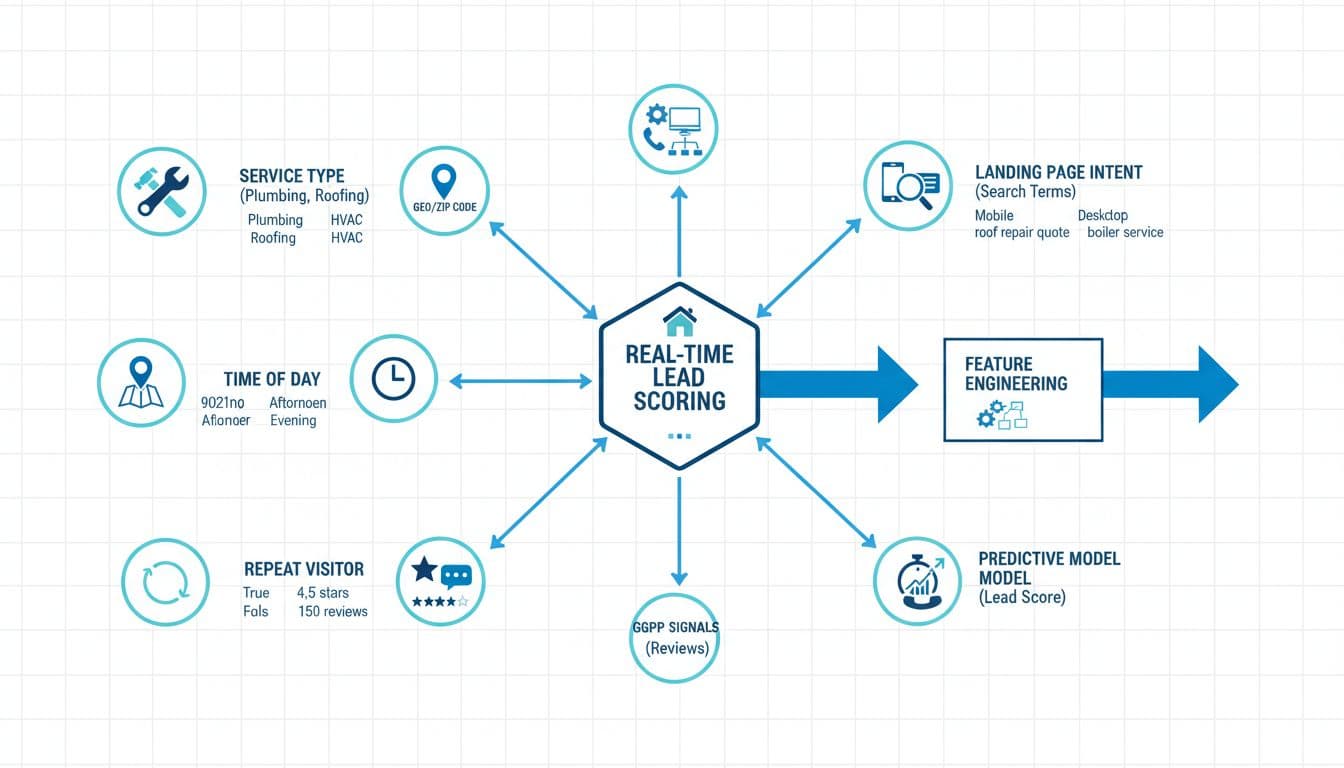
Strong, practical features include:
Service type and urgency: “Emergency plumber” behaves differently than “gutter cleaning.” Even within one trade, intent varies by page.
Geo fit (ZIP or radius): A lead 3 miles away is not the same as 30 miles away.
Time of day and day of week: After-hours calls often signal urgency (and higher close rates) for certain trades.
Device: Mobile click-to-call traffic tends to be more immediate than desktop browsing.
Call details: Call duration, repeat calls, missed calls, and whether the caller pressed “1” to connect (if your system supports it).
Repeat visitor and page path: A visitor who hit pricing, reviews, and a service page is warmer than someone who bounced.
Google Business Profile signals: If you can connect GBP insights and review themes to lead source, it adds context for quality and trust.
A simple starting scorecard can be rules-based. It’s not “AI,” but it works and creates training data for the next step.
| Signal | Example | Score impact |
|---|---|---|
| Service page intent | Emergency repair page view | Higher |
| Geo match | Within service ZIPs | Higher |
| Call duration | Over 90 seconds | Higher |
| Missed call | Rang out, no callback | Lower |
| Off-hours | Weekend night | Depends on trade |
| Repeat visitor | Second visit in 48 hours | Higher |
Most small businesses should build this in two phases.
Rules let you launch in days, not months. They also help you answer, “Why did this lead score high?” without a data science degree.
Once you have enough labeled outcomes, move to something practical like logistic regression or gradient boosting. The goal isn’t fancy math, it’s better ranking of leads.
If you want the score to adapt quickly (seasonality, weather spikes, new service pages), consider “online learning” or frequent retraining. In January 2026, more home service marketers are also using chat and conversational forms to capture details without long forms, then feeding those responses into scoring so dispatch gets better context right away.
For a plain-English explanation of how real-time scoring works and why it updates continuously, this overview from AI for Businesses is a useful reference: how real-time lead scoring works.
A score is only useful if it changes behavior.
Set clear actions by score band:
Also add “reason codes” so your team trusts the system (example: “High score because within 3 miles, viewed emergency page, call lasted 4:12”). Trust is what turns scoring into speed.
This pairs naturally with a results-first approach to SEO. If your agency is held to outcomes, you want proof that the SEO traffic is producing booked work, not just activity. That’s also why trade-specific SEO content matters, because the page itself becomes a scoring signal. For example, a tightly aligned service page strategy like the one in this gutter repair SEO guide tends to attract clearer intent than broad “services” pages.
Real-time systems drift. Seasons change, competitors change, and Google changes. Watch for:
Calibration: Do “80-point leads” really book more than “50-point leads?”
Data gaps: Ad blockers, missed calls, or a CRM that isn’t updated can poison training data.
Spam and fraud: Filter repeat spam numbers and obvious bot forms early.
Lead value: Not all booked jobs are equal. Track revenue, cancellations, refunds, and repeat work when you can.
When you can connect rankings, leads, and revenue cleanly, performance SEO becomes a lot simpler to price fairly. You’re not paying for promises, you’re paying for outcomes you can see.
Home service marketing moves fast because customers move fast. A real time lead scoring model makes sure your team responds like a well-run dispatch, not a first-come, first-served inbox. Start by defining what a good lead means, capture the right signals, launch with rules, then train a model on booked jobs. If you’re serious about performance-driven SEO, the score becomes your truth source, and it keeps everyone focused on results that actually hit the bank.


