
A service page can miss page 1 even when the business behind it is solid. Most of the time, the page is not failing because of one magic number. It fails because it feels thin, vague, or hard to trust.
For most small businesses, service page SEO works best when the page lands around 500 to 1,000 words. That range usually gives you enough space to explain the service, show proof, answer objections, and ask for the lead. The trick is knowing when more helps, and when more only adds noise.
There is no perfect word count. Still, most local service pages do well when they are long enough to feel complete, but short enough to stay focused.
A good starting point is 500 to 1,000 words. That is often enough for plumbers, roofers, cleaners, dentists, electricians, and other local services. If your page has less than 300 words, it may look more like a placeholder than a real sales page. On the other hand, if you stretch a simple service page past 1,200 words, you often start repeating yourself.
That is why broad studies about long-form content need context. A recent average content length report shows that many top-ranking pages are much longer, but those results often include blog posts and guides. A local service page is different. It has to help someone hire you, not read a mini-book. The same point comes up in this practical guide on SEO content length: intent matters more than raw length.
This quick guide helps set expectations:
| Service page type | Strong starting length | Why it works |
|---|---|---|
| Simple local service | 500 to 700 words | Covers offer, area, proof, and CTA |
| Competitive or high-ticket service | 800 to 1,200 words | Needs more trust, detail, and FAQs |
| Branded or low-competition page | 300 to 500 words sometimes | Can work if trust signals are strong |
The pattern is simple. Write enough to remove doubt.
If your page says, “We offer tree trimming, call now,” that is not a page. It is a business card taped to a wall.
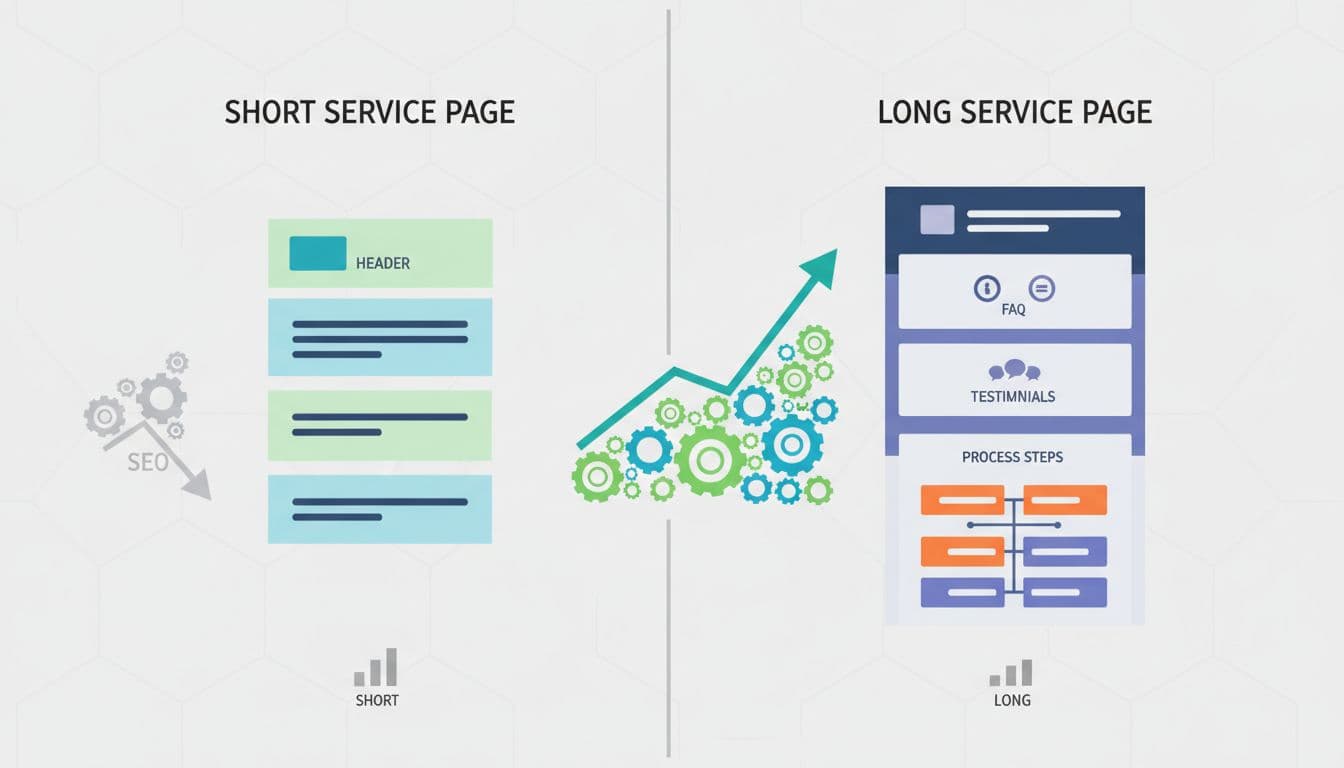
Word count only matters if the words do useful work. A strong service page does not ramble. It answers the buyer’s next question before they have to ask it.
That usually means the page includes the basics below, written in plain language:

When those elements are missing, owners often blame the length. Yet the real problem is structure. Many examples of why service pages fail to rank come back to the same issue: the page never proves why this business is the right choice. A recent piece on how to improve SEO rankings for service pages makes the same point.
Google does not need the longest page. It needs the clearest answer for a hiring decision.
Think of it like a sales call. If the buyer still does not know what you do, where you work, what makes you trustworthy, and how to contact you, the call is not going well. Your page should fix that.
Local details help a lot here. A generic “kitchen remodeling” page is weaker than a page that mentions service areas, timelines, permits, materials, and recent jobs in the market you serve. That extra detail is what turns a plain page into a convincing one.
Small business owners often hear the same advice: add more content. Sometimes that works. Often, it does not.
If the page already explains the service, shows proof, and answers objections, adding another 300 words may only bury the good stuff. It is like a salesperson who keeps talking after the customer is ready to buy. More words can lower clarity.
This is where performance-minded SEO is different. The real question is not, “How long is the page?” It is, “Did the page move closer to calls, forms, and booked jobs?” That is why a 30-day SEO scorecard for leads is more useful than staring at word counts or traffic charts.
Results also matter because service pages are money pages. A blog post might pull in visits, but the service page should bring buyers. If you want SEO judged by rankings and lead flow instead of busywork, that is the logic behind results-based SEO campaigns. Small businesses do not need thicker reports. They need pages that help the phone ring.
So, when should you add more content? Add it when the page still leaves gaps. Maybe it needs a short FAQ, stronger reviews, clearer service-area details, or a better explanation of your process. Cut content when it repeats claims, pads out sections, or wanders into blog territory.
Most service pages do not need 2,000 words. They need enough useful copy to build trust and make the next step easy.
Start around 500 to 1,000 words. Then compare your page with the best pages in your market, add missing proof, trim repeated lines, and track lead quality. If the page still stalls, do not ask how to make it longer. Ask what would remove the last bit of doubt.


