
If you’re a home service business owner, you’ve probably heard promises like “pay per lead” or “pay only for results.” It sounds clean. It sounds fair. Then the leads start coming in and you notice something uncomfortable.
Not every “lead” is equal.
That’s why true cost per lead matters. It’s the number that tells you what you’re really paying for a qualified opportunity, after you account for junk calls, missed calls, admin time, and the hidden costs that don’t show up on an invoice.
Pay-for-performance SEO flips the usual deal. Instead of paying a big monthly retainer no matter what happens, you pay when rankings (and often lead results) show up. That model can lower risk, but it doesn’t automatically protect you from bad math.
Here’s the trap: many providers (and even business owners) calculate CPL using the easiest number available, like total spend divided by total calls.
That’s like pricing every fish the same at the dock, even though half the bucket is minnows.
A basic CPL formula is helpful, but it’s not the full story. If you want a plain-language refresher on what CPL means, Shopify has a simple overview of what cost per lead is.
In home services, the real question isn’t “How many calls did we get?” It’s “How many calls were worth answering?”
Before you calculate anything, lock down what counts as a lead. The fastest way to end arguments with a vendor is to define your stages in writing.
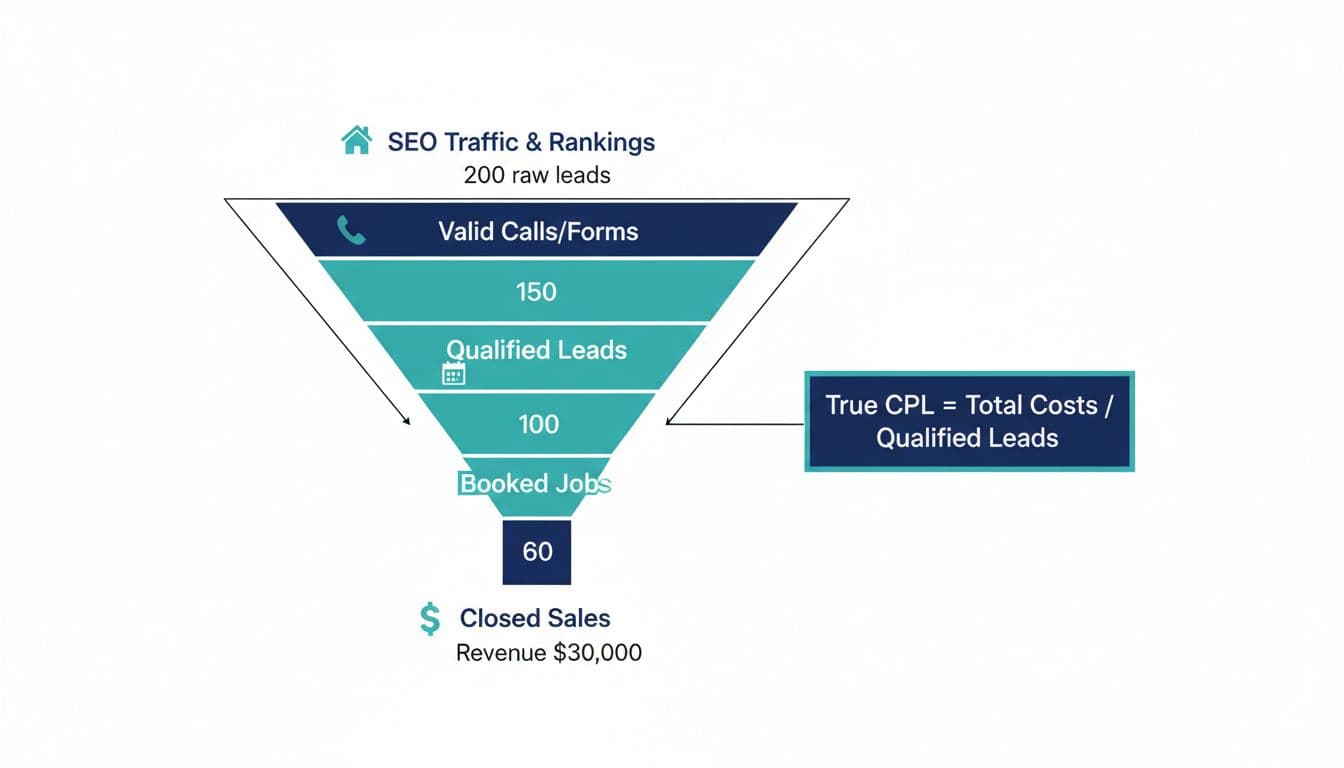
Use a funnel like this:
If your provider reports “leads,” ask which stage they mean. If you only track raw contacts, your CPL can look great while your schedule stays empty.
True cost per lead should be built on qualified leads, not raw contacts. Then you add all costs required to create and capture those leads.
Here’s a practical way to think about it:
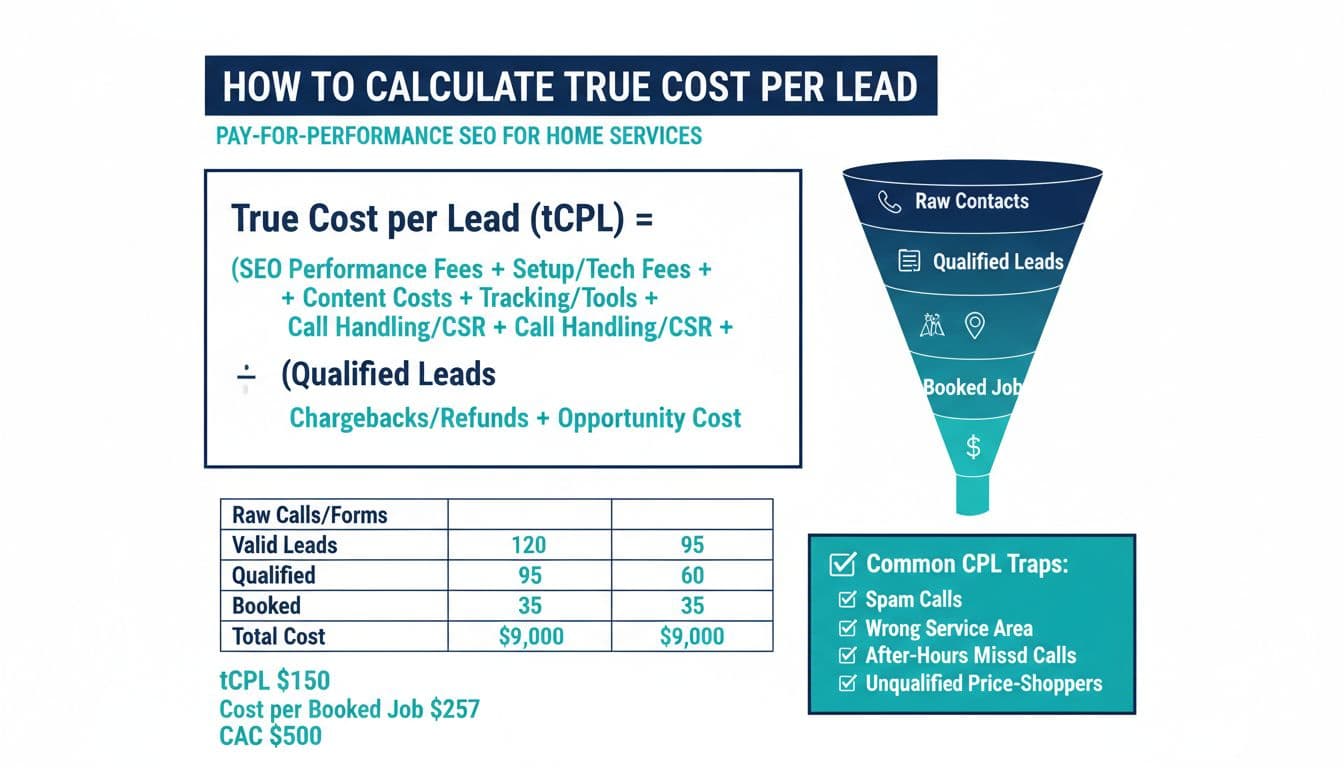
True Cost per Lead (tCPL) = Total lead-generation costs ÷ Qualified leads
Total lead-generation costs often include more than the SEO invoice.
| Cost bucket | What it looks like in real life |
|---|---|
| SEO performance fees | Pay-after-ranking fees, lead-based fees, or milestone payments |
| Setup and tech fees | Tracking setup, landing pages, site fixes, call tracking install |
| Content costs | Service pages, location pages, photos, project write-ups |
| Tracking and tools | Call tracking, form tracking, CRM seat, reporting tools |
| Call handling and CSR time | Time spent answering, screening, logging, follow-ups |
| Chargebacks and refunds | Disputed charges, invalid lead credits, refunds issued |
| Opportunity cost | Missed calls after hours, slow response time, no-shows |
That last one matters more than most owners expect. If the phone rings and nobody answers, you still paid to make it ring.
If you want to understand how performance-based models are supposed to work (and what they’re good at), this overview of the benefits of pay‑for‑performance SEO lays out the idea clearly.
Let’s use an HVAC company running pay-for-performance SEO.
Step 1: Choose your time window.
Use a clean month (or 28 days) so you can compare month to month.
Step 2: Add up total costs tied to organic lead generation.
Example monthly costs:
Total cost = $9,000
Step 3: Count qualified leads, not raw calls.
Example lead counts for the month:
Step 4: Do the math.
True cost per lead = $9,000 ÷ 60 = $150
Now you have a number you can use.
You can also calculate two other “truth checks” that owners care about:
A tCPL of $150 might be amazing if your average ticket is $1,800 and your close rate is strong. It might be awful if your jobs are $250 tune-ups and half the leads are price shoppers.
Most lead problems don’t come from rankings. They come from counting and handling.
Watch for these issues:
Spam and repeat callers: If you don’t de-duplicate, you overcount leads fast.
Wrong service area: Ranking wider than you serve can create “leads” you can’t take.
After-hours missed calls: A missed call is still a paid lead source.
No tracking clarity: If you can’t tie a lead to SEO, your CPL is guesswork.
Loose “qualified lead” rules: If “qualified” means “they asked a question,” your tCPL will lie.
A clean fix is to agree on what counts as qualified, then back it up with call recording, call disposition tags, and a simple approval process.
It also helps to know exactly what you’re paying when results start. A transparent pricing page makes comparisons easier, including pay‑for‑performance SEO rates.
Once you know your true cost per lead, you can compare channels like you’d compare trucks: same load, same road, same fuel.
Benchmark data can help you sanity-check your numbers. For example, industry CPL reports and roundups for 2025 to 2026 show home services CPL ranges that swing widely by trade and market competition. In many areas, HVAC and plumbing leads can land in the tens of dollars, while roofing often costs more, and $150+ leads aren’t rare in competitive metros. Use sources like First Page Sage’s Average Cost Per Lead by Industry – 2026 as a reference point, not a promise.
If your tCPL is higher than PPC, don’t panic. SEO leads often improve over time as rankings spread, content grows, and your brand gets searched by name. Your job is to track the trend and keep the counting honest.
A “cheap lead” isn’t cheap if it’s spam, out of area, or missed at 7 pm. Calculating true cost per lead forces reality into the conversation, and it makes pay-for-performance SEO easier to judge.
Start by defining lead stages, add up every cost tied to generating and capturing demand, then divide by qualified leads only. Once you have that number, you can compare channels, spot waste, and decide what to scale with confidence.


